
Yesterday I wrote about the danger of letting fear and hatred blind us to our shared humanity, as “March for Australia” protests and counter-protests swept across the country.
Today, my friend’s car was vandalised with the words: “Go back to where you came from, Fucking Fag.”
His Indigenous and Trans ally stickers were scribbled out.
He is of Indian heritage, brown-skinned, openly allied with Aboriginal and Trans communities. His skin colour and those stickers made him visible as someone who believes in solidarity and inclusion – someone brave enough to live openly for what is right. That visibility made him a target. These vandals don’t see the warmth he brings to the world, the contributions he makes to Australia and the kindness he exudes in the work he does.
This is not just vandalism. It is a message meant to intimidate, silence, and divide. It is the real-world consequence of movements that dress themselves up as “ordinary Australians taking their country back” but are seeded with racism, white nationalism, and hate.
And here’s the truth: I understand and sympathise with the frustrations many Australians are feeling. We have fought hard – and still fight hard – for the values that became our privileges: civil rights, education, housing, welfare, a fair go… our larrikin spirit. I too fear these things being threatened.
But it isn’t immigrants’ fault.
This insecurity, frustration, and fear is what Donald Trump so cleverly harnessed. It is poor governance – delusion, false security, gaslighting its citizens. People see it, and they are rightfully angry. But it is our Government who must be accountable for defining and protecting the values we hold dear, and for expanding those privileges to all Australians.
This is what happens when hate is given oxygen. It’s not an isolated act of cruelty. It’s a symptom of something much larger taking hold in our streets, our politics, our conversations.
I keep thinking about 1930s Germany. Ordinary people, struggling, scared, angry, were handed a convenient enemy – immigrants, Jews, queers, “degenerates,” anyone who could be blamed for failures in war or governance. Fascism doesn’t always arrive in black uniforms with swastikas. It grows in the shadows of half-truths, tokenistic policies, and empty slogans.
We are living through what I call “fascism painted green.” On the surface it looks like inclusion, sustainability, progress. But when governments make symbolic gestures without structural change – rainbow flags in June while trans people are unsafe; Acknowledgements of Country while Aboriginal deaths in custody continue; “green” policies that privilege corporations while people can’t afford rent or food – it breeds resentment.
To “ordinary Australians,” all they see are tokenistic policies while their real needs go unmet. They call bullshit on governments that claim they’re “doing something” when nothing changes. What they see is endless talk of “inclusion” while their kids are bullied at school, their wages don’t stretch, and housing feels impossible. So they look at the slogans of “inclusive” politics and think: it must be the Indigenous, the Queers, the Immigrants who are benefiting.
But the truth is, they aren’t. Those communities are still unsafe, still discriminated against, still struggling. No one is winning here – except the politicians who get to pretend they’ve delivered change, and the top 1% who count their coins while the rest of us are kept divided. Everyone is being gaslit.
And resentment is tinder. It sparks the belief that inclusion is a trick, that equality means someone else’s gain is your loss. That’s the story the far-right is waiting to tell. And it’s the story too many people are starting to believe.
That resentment is weaponised. The far-right feeds on it. They take very real frustrations – about housing, wages, climate, cost of living – and redirect the anger away from systems of power, onto scapegoats: migrants, Blakfullas, queers. Hatred becomes easier to organise around than justice.
That’s how you get marches where neo-Nazis feel comfortable walking beside “ordinary” Australians. That’s how “taking our country back” becomes slogans sprayed on cars, fists thrown in the street, fear settling heavily in communities who already carry too much of it.
We have to name this for what it is. Fascism is gaining momentum – not in spite of inclusion efforts, but because so many have been shallow, tokenistic, and easily co-opted. On one side, the right exploits fear to scapegoat. On the other, the left too often retreats into symbolism and a culture of offence that alienates instead of uniting. Both extremes feed the fire.
And here’s the truth: we cannot fight fascism with slogans or symbolism. We fight it with courage. With structural change. With solidarity that costs us something. By remembering that difference is not a threat, but the very fabric of who we are.
So the question becomes: what are our core values as a society – and how do we protect them fiercely, without rejecting whole peoples and harming others in the process?
Because if we forget that, if we abandon humanity for the illusion of security, we’ve already lost the very freedoms we claim to defend.
The lesson of history is flashing in red. We ignore it at our peril.
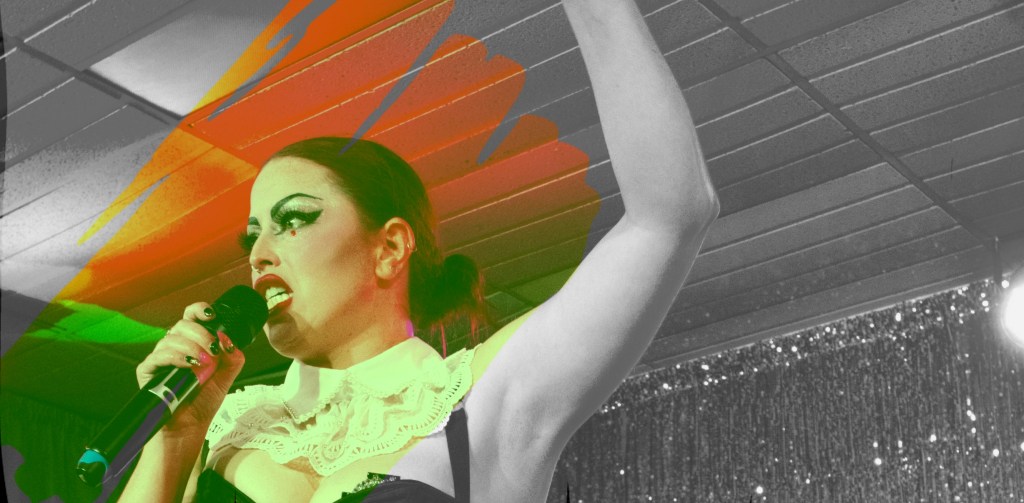

 Delicate Feral – Bambi-Rose Woodward