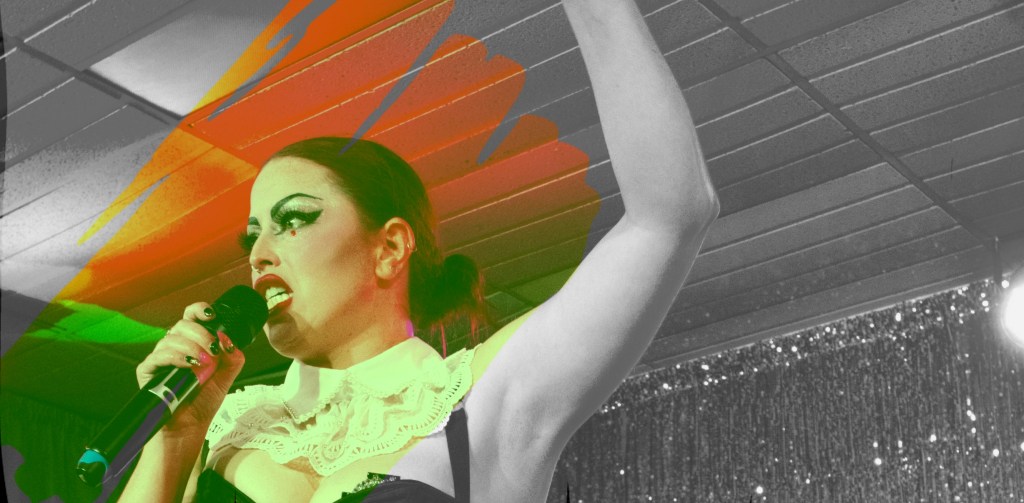
Bambi Valentine performing “What Keeps Mankind Alive”. Since edited, original photo by Nathan J Lester.
Activism is not immune to authoritarianism. When you shut down any opposing or critical thought of your view and/or punish the opposer for expressing them, it becomes tyranny. It is the same behaviour that puts communism into the hands of tyrants – it’s fascism painted in green.
I wrote an article that was critical of this behaviour, referencing a prominent Australian feminist. Despite acknowledging my agreement with most of her views and even supporting her strong work and advocacy for years, I was tagged in posts referring to me as a “Liberal White Feminist” who was aligned with “Genocidal Zionists.” I was accused of not being vocal about a range of issues – despite having no obligation to prove myself a “good girl” or a “good leftie” to any faceless person behind a keyboard – and trying, myself, not to replicate that same intellectual elitism when I internally dismiss them as an ignorant fool.
Not only does this redirect discourse away from the very cause they claim to fight for – it also trivialises and dilutes the actions of actual “genocidal zionists”.
The striking part was this: the very behaviour I was calling out, was the behaviour now being directed at me.
Despite an increasing number of far-left activists (whom I have and do largely align myself with) choosing an “other” then labelling anyone who dares display critical thought that “other” — they replicate a tactic long used by dictatorships and fascists: you pick an enemy, a “bad guy,” and anyone who disagrees or even questions you becomes that bad guy — or is accused of sympathising with them, regardless of their actual views or intentions.
Donald Trump’s administration conflates dissenters with being transgender, queer, woke, or Palestinian. Israeli lobbyists weaponise accusations of antisemitism. The Nazis targeted Jewish and LGBTQIA+ people, using slurs like degenerate, cultural Bolshevism, and Jewish intellectualism to discredit dissent and justify violence. This tactic dehumanises. It silences. It shames. It shuts down critical thought and poisons discourse — and ultimately, it paves the way for moral disengagement and the justification of harm.
Am I calling far-left advocates Nazis? No. That’s not my belief, my aim, or my point. But the behaviour I’m witnessing follows a recognisable pattern — and if we don’t name it, we can’t claim integrity in the fight against inhumanity.
It’s important to me to write this in the midst of such radical change and disarray in the world. You might ask – why this, and why now? When there are so many urgent, direct crises I could be writing about – and do. One reason is that there are others who can speak to those things more directly, and I’m committed to learning from, sharing and amplifying those voices. But another reason is this: I’m seeing harm within activist spaces that is not only blocking progress, but beginning to mirror the very systems we claim to fight against.
There is a very real and violent assault on precious lives happening right now. And it’s because the stakes are so high that I feel compelled to draw attention to what’s unfolding in our own communities. When we slander others – not because they have vastly different ideals, but because of how they approach the matter or how they understand a matter – Who is reading? Who is listening? Who is being empowered, and who is being silenced? What progress is being stalled? And how is this serving your cause – really?
It’s important to speak about this because so many people are afraid to talk about important issues. They’re not just afraid of far-right slander or sexism and racism. They’re afraid of getting torn apart by the people they’re usually aligned with. They’re afraid they won’t be backed up if they draw attention to an issue. Sometimes they cop more vitriol from their own than from the opposition.
This doesn’t progress a cause. It impedes it. It discourages awareness, conversations, strategy, and growth. We ridicule people for staying silent and upholding the status quo, but we also create a culture where speaking up imperfectly gets you dogpiled. Yes, we should call out when people shout over marginalised voices or perpetuate harm. But can we do it in ways that don’t replicate cycles of violence? That doesn’t humiliate, alienate, or silence?
It doesn’t mean POC takes a back seat. It means: educate, don’t humiliate. Call in before you call out. Yes, white feminist rhetoric can be problematic. Yes, we should name it when we see it. But my dear friend put it well the other day, when I was venting about an uninformed take that felt harmful:
“But no one has ever had their views changed or altered by being called a bigot, a homophobic etc. Doesn’t create a dialogue, doesn’t allow education. And it’s your choice whether you want to educate or not.”
To which I responded: “Fuck off.” (Okay, not really – I said something much worse, which makes me a hypocrite in this article. But hey, at least it wasn’t public and also… growth, right?)
There’s so much “no but-ing” and not enough “yes and-ing” in activist spaces. Horns locked. No progress. No room for pragmatic resolve.
There’s room for outrage. Hell, there’s a necessity for it. There’s a necessity to scream. But differing strategies matter too. These aren’t competing forces – they’re part of a larger ecosystem of resistance. Screaming works for some. Lobbying works for others. Organising, storytelling, policy-making, mutual aid – it all matters. Different people bring different tactics. Different people resonate with different voices. Different people connect with simple language, some with complex. That’s how we win.
Not everyone has the right words. Not everyone can “read a book”, let alone write one. Not everyone agrees or resonates with your method. But different doesn’t mean wrong. Different doesn’t mean less. And different definitely doesn’t mean fascist.
And all too often, I witness the hypocrisy – and dare I say, the immorality – of those who scream the loudest but lack depth. The banner-wavers who go quiet when it impacts them personally. Who disappear when it’s time to show up for someone vulnerable in their own community.
Meanwhile, people with the most day-to-day integrity – the ones doing the work in their own circles – often are people who speak imperfectly. They make politically incorrect statements. They don’t have the right words. But they care. They’re trying.
A KREWD Chorale, You Are Here 2015. Photo by Adam Thomas.
Clementine Ford is a bully, and I’m calling it out. I believe in her voice and her voice matters – but so does the harm she’s causing.
And that’s hard to say because what she speaks about is important. Her voice is essential. She has contributed enormously to feminist discourse in Australia. Her words have shifted public conversations around gender, power, and violence. Her ideals are, for the most part, aligned with mine. I believe in her passion. I believe in many of her points. I believe she is often right, but I cannot excuse intimidation, bullying and harassment.
Because this isn’t about her beliefs. It’s about her behaviour.
Her platform isn’t being used for collective liberation, it’s being used to dominate. To shame. To punish difference, not just indifference. She doesn’t just disagree; she obliterates. She speaks with contempt. She controls the tone of the conversation through fear and superiority. And she has built a reputation that keeps people afraid to speak up, because they know what happens when you end up on her bad side.
That’s not activism. That’s not justice. That’s domination dressed in moral righteousness.
Her obsession with Abbie Chatfield has become disturbing. Abbie didn’t engage with the bullying. She didn’t retaliate or spiral into online warfare – she tried to keep her focus on her own work, in her own lane.
When I was critical of Clementine in a post she had shared about Abbie, she responded: “Your hero [Abbie] will survive being challenged, you may not be so robust.”
What. The. Actual. Fuck?!
Abbie – who is great, but let’s be real, she’s not exactly Linda Hamilton in Terminator 2 – can survive being challenged. But that’s not what Clementine is doing. This isn’t intellectual discourse anymore. It’s grown into relentless public shaming across multiple platforms. Clementine is sitting on a moral throne and unleashing the trolls – knowingly fuelling the far-left to join with the far-right trolls who already threaten, abuse, and harass Abbie regularly.
Now Abbie, someone who has publicly shared her experiences with ADHD and trauma, has been triggered and pushed into what looks very familiar to me as an episode of ADHD overwhelm and/or a complex PTSD spiral – crying, pleading: “Leave me alone! Please don’t do this. Please don’t stop me and other people talking about Gaza!”
And you know what? Valid.
The emotion is valid. The overwhelm is valid. The fear is valid. Because what’s happening here isn’t feminist accountability – it’s cruelty in activist clothing. The way she’s being torn to shreds and dehumanised is, quite frankly, disgusting.
Abbie will, of course, be ridiculed for “not being accountable” or for “ignoring valid criticism” or “putting energy into this instead of stopping a Genocide” – but that’s just textbook gaslighting. It reframes her explosive reaction as over-sensitivity or misguided hurt, instead of what it actually is: a human response to sustained personal ridicule, bullying, and harassment.
Is Abbie Chatfield perfect? No. None of us are. We shouldn’t have to be perfect to be treated with respect. Her imperfections do not justify obsession, endless ridicule, or public harassment. We have to hold space for imperfection within activism – or we create a climate where only the loudest, most aggressive voices survive – and they’re not always the most effective for change or recruiting allies.
Clementine is a black-and-white thinker. She seems to lack the one thing necessary for actual change: pragmatism. And this is the core issue.
When activism gatekeeps with intellectual elitism, it becomes inaccessible to some and alienating to many. When Clementine – or any intellectual – intimidates or shuts down anyone who doesn’t meet their bar or match their aggression, they climb up onto a moral pedestal (or petty-stool), and cut people down from it. It’s elitist bullying disguised as conviction. Yet it often silences the very people they claim to be ‘helping’ or ‘liberating.’
Sound familiar? It’s tyranny cloaked in activism.
When idealism burns so hot it scorches pragmatism, we risk losing the very change we claim to fight for. Her idealism is powerful, but power without care becomes control.
In our passion for justice, we can’t forget that pragmatism is what turns ideals into impact – not every path has to look the same to be moving forward.
We can disagree on tactics. We can approach the same cause from different angles. But if we abandon respect and turn on each other in the name of justice, we risk becoming aggressors ourselves – there’s room for different tactics without abuse.
Even I have been afraid to speak out about Clementine’s behaviour, me without a enormous platform. I do feel afraid that perhaps I won’t be so “robust” to “survive” a Clementine attack as she so curtly pointed out. I am vulnerable. I am a queer single mother, neuro-divergent, living with complex PTSD, and in active survival mode. I know how cruel and dehumanising her attacks can be, and I’ve watched how she goes after anyone who questions her methods. And still – my voice matters too and I believe it’s important to say something. Because until we name this behaviour, others will remain too scared to engage in activism at all.
There has to be space for people to use their privilege to speak about genocide, injustice, and harm – and to do so in ways they feel is safe for them and that they can sustain. It’s not accessible for everyone to march, shout, or perform public rage. Some are struggling to survive while resisting. Some don’t have higher education. Some are illiterate. Some can’t “read a book”. Some believe in other pragmatic ways of fighting systems that condone violence – or need to choose paths that feel safer, but not necessarily less effective.
This isn’t a takedown of feminism. It’s a call to protect it from the rot of ego and cruelty. We don’t all have to agree. But we do have to stop tolerating bullies just because they say the right things loudly. A politics that relies on cruelty isn’t justice. It’s just power, repackaged.



 Delicate Feral – Bambi-Rose Woodward